
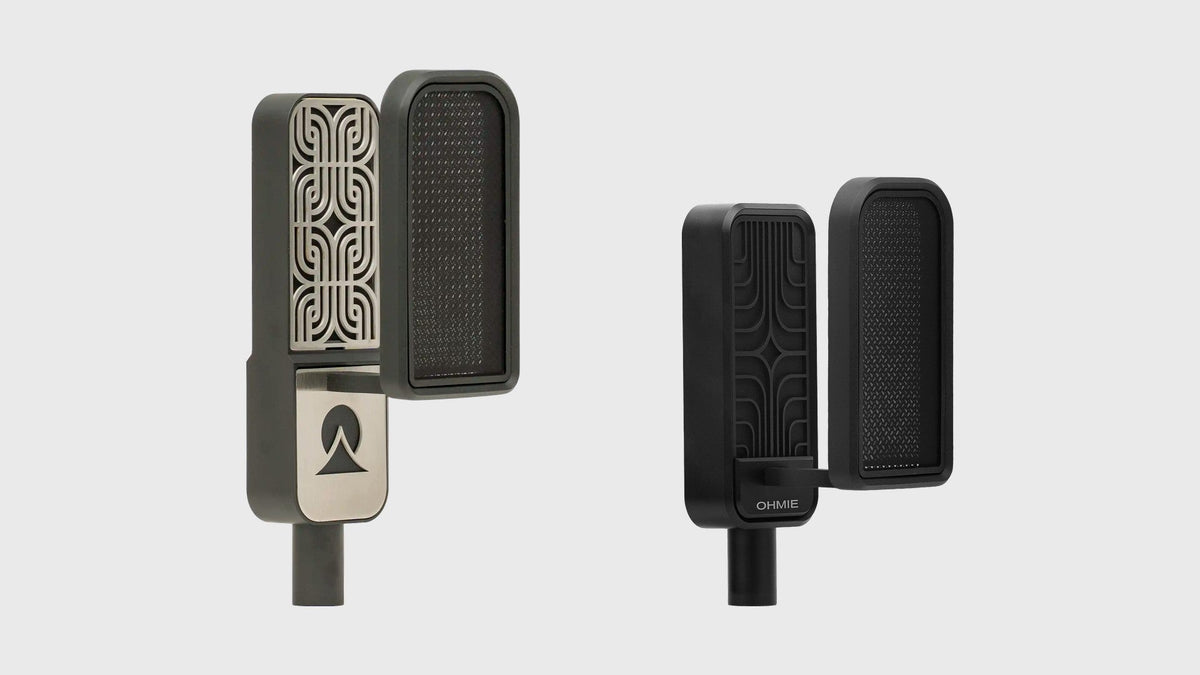
Why are we still clamping giant circles onto our microphones? We've been asking that since Ohma's first year. Most pop filters are a hoop of nylon on a gooseneck, clamped to your stand and bent into place before every take. Ours attach to the mic itself with magnets.
There are two of them, one for the Ohma Ribbon and Ohma Condenser and one for the Ohmie. They're the same pop filter. What changes is how each one snaps on. Here's how they work, and how we got here.
It started at Pride
The first pop filter we finished was built for Janelle Monáe. In June 2023, ACLU SoCal asked us for a trans flag microphone for their float at the LA Pride Parade, three days before the parade. We painted the mic in the colors of the trans flag, and built a hot pink pop filter to go with it, one that attached to the mic instead of hanging off the stand.

Janelle Monáe and our first pop filter at LA Pride, June 2023. Photo by Ashley Balderrama.
That one was made for a parade. Turning it into something anyone could buy took a lot longer. (The full story of the Pride mic is here.)
Three years of prototypes
The Pride filter was the first one we finished, not the first one we tried. We were already printing frames and holding them up to our mics in early 2023, and we've kept at it ever since, in between everything else. We weighed 3D printing against CNC machining and outside manufacturing, and went back and forth between plastic and metal. We fought with finishes, smoothing frames by hand and testing textures. We tested fabrics, printed lattices, magnet layouts and a desk stand to hold the filter when it's off the mic.
2023
The first frames were plain outlines, held up to the mic to find the right size and distance.


Early frames, February and May 2023.
2024
Then came color, fabric, and the lattice that keeps the fabric flat.


Frames with fabric, September 2024, and a printed lattice, December 2024.
2025
In 2025 we went deep on fabric and metal. Every version starts as a 3D model, which we print, test on our mics and change again.


A fabric test, June 2025, and a metal frame in a printed test base, October 2025.


The pop filter in Blender.
2026
By the summer of 2026, the prototypes had taken over the shop floor.


Char on a floor full of prototypes, and lattices, fabrics and frames laid out, July 2026.
The hard part
Stopping air is easy. Almost any dense material will do it. The hard part is stopping the air without changing the sound.
When you sing or speak close to a mic, P and B sounds push out a burst of air. If it hits the capsule or ribbon head on, you hear a low thump that's hard to clean up later. That burst is different from the sound of your voice, and a good pop filter treats them differently: it breaks up the moving air and lets the sound through. A denser material stops more air, but it can also dull the voice. A more open one keeps the voice clear but lets plosives through. On top of that, the filter has to handle breath and moisture, keep its fabric tight and even, stay put, and be something we can build the same way every time.
How it works
Both pop filters use the same filter. A frame holds a layer of acoustic fabric over a supporting lattice. The fabric breaks up the burst of air from plosives. It's the same hydrophobic technical fabric we use in our microphones, made for exactly this job: it sheds the moisture that comes with close vocals instead of soaking it up. The lattice keeps the fabric taut and even. And the frame holds all of it at a set distance in front of the capsule, which gives the air room to spread out before it reaches the mic and keeps your placement the same from one take to the next.
What's different is how it snaps on.
On the Ohma Ribbon and Ohma Condenser
The Ohma mics are built around magnetic screens you can remove and swap, and the pop filter uses the same system. Its base is a logo screen. Remove the front bottom screen of your mic with a guitar pick (here's how), and the pop filter's base snaps into that slot, held by the same magnets that hold every other screen. The filter sits in front of the top screen, right where you sing. To take it off, put your bottom screen back and set the filter on its desk stand.


The Ohma pop filter's base is a logo screen. It snaps into the front bottom slot of the mic.
Ready-made, it comes in black, stainless steel, apricot and brass. If you build your mic in Build your own Ohma, you can add a pop filter that matches it, down to the fabric color and a custom logo.
On the Ohmie
The Ohmie doesn't have swappable screens, so its pop filter attaches a different way. A magnet hidden behind the logo on the front of the mic holds it in place. Line it up and it snaps on. It comes off in a second when you move on to an acoustic guitar, a room or a field recording, and rests on its own desk stand until you need it again.


The Ohmie Pop Filter snaps onto the front of the mic.
You can get it on its own or with the mic as the Ohmie + Pop Filter Bundle.
Why we built it this way
If you've recorded with a gooseneck filter, you know the routine: set the distance, tighten the clamp, start the take, and notice ten minutes later that it has sagged an inch. A filter that's part of the mic takes care of that.
- The distance stays put. The filter sits where it was designed to sit, every session.
- It moves with the mic. Angle the mic or swing it on a boom arm and the filter comes along.
- Your setup stays clean. No extra clamp on the stand and nothing crowding the mic, which you'll notice on camera.
- It's quick to take off. Leave it on for vocals, voiceover and podcasts. Take it off for instruments and rooms, and park it on the desk stand.

Marie Jenkins with the Ohmie and its pop filter.
Pop filters for podcasting
Podcasts are where a pop filter earns its keep. You sit close to the mic for an hour or more, talking, laughing and leaning in, and every hard P is aimed straight at the capsule. A filter that's part of the mic stays at the same distance however much the conversation moves, so the end of the episode sounds like the start.
With two or more people at the table, each mic carries its own filter, and there are no extra stands or goosenecks crowding the space. If you film your podcast, there's no hoop in the shot, just the mic. That works the same on the Ohmie, the Ohma Ribbon and the Ohma Condenser.


Podcasting and spoken word with the Ohmie Pop Filter.
Which pop filter fits my mic?
- Ohma Ribbon or Ohma Condenser: the Ohma pop filter.
- The Ohmie: the Ohmie Pop Filter.
They share a filter, but they aren't interchangeable, since each one snaps onto its own mic its own way. Both are assembled in our East LA workshop, alongside the mics they're made for.
Questions
Do I need a pop filter?
If you're recording vocals, voiceover or a podcast up close, yes. It keeps plosives and breath off the mic. For instruments, rooms and field recording, you usually don't need one, which is why ours come off so quickly.
Does the Ohma pop filter fit the Ohmie, or the other way around?
No. The Ohma pop filter fits the Ohma Ribbon and Ohma Condenser. The Ohmie Pop Filter fits only the Ohmie.
Do I have to remove a screen to use the Ohma pop filter?
Yes, the front bottom screen. The pop filter's base takes its place. Put the screen back when you take the filter off.
What comes in the box?
Each pop filter comes with its own desk stand. The Ohmie Pop Filter also comes with two picks.
Can my pop filter match my custom Ohma?
Yes. Add a pop filter when you build your own Ohma, and it's made to match your mic, including the fabric color and a custom logo.


